How the projects are intended to work together
I build free tools for people and the groups they belong to: Conscious Consuming to compare everyday products and services by what you care about, Kosplora to learn a subject by a route with its sources shown, the Socratic Hearth and the Work Party for a group to talk a question through and write down what it agreed, and Basic Dignity for the rules a group owes its people. This edition sets out how they are meant to work together.
This edition explains the proposed mechanisms, the projects already available and the evidence needed to judge the results. It develops the visual atlas into a readable account. The combined system and its wider effects have not been demonstrated.
Contents and section links
The proposed change
A theory of change describes why an activity might lead to a useful result, and which assumptions could fail. Here, the aim is to connect digital tools with decisions made by people and work carried out in physical places.
Learning
- What is providedResources, practice and feedback
- How it could helpPeople attempt a task, explain their reasoning and correct mistakes.
- Intended resultUnderstanding they can apply to a different task, with appropriate accessibility support.
Cooperation
- What is providedDiscussion, agreements and shared records
- How it could helpPeople identify disagreements, agree responsibilities and review what happens.
- Intended resultUseful work completed, with the people affected able to question or change the arrangement.
Services and resources
- What is providedNeeds, alternatives and maintenance information
- How it could helpPeople compare repair, sharing and purchases against cost, access and upkeep.
- Intended resultServices that meet a need and can be maintained or replaced without excessive burden.
These are proposed causal connections. The arrows do not represent measured effects.
Each connection depends on time, accessibility, resources, legitimate authority and maintenance. Wider conditions also matter: a learning tool cannot by itself supply income, housing or public services. More activity on a website would not establish an improvement in any of these outcomes.
Projects and availability
These existing sites provide parts of the proposal. Some tools exchange files, but the complete workflow, a shared assistant and credential assessment are not built. The descriptions below separate present functions from their intended role.
Kosplora
Early. Educational resource library, simulations and digital-literacy guides.
Intended role and limits. Learning environments and credible demonstrations of understanding. Credential assessment is not built.
Where it is. kosplora.org
Conscious Consuming
Live. Product and service comparisons on Values Commons, with sources and adjustable priorities.
Intended role and limits. Compare options for a shared project, including repair and reuse. A group procurement workflow is not built.
Where it is. valuescommons.org
Dignity Needs
Live draft. A reference on human needs and possible responses.
Intended role and limits. Record what a particular group needs. The published example is not a community-adopted agreement.
Where it is. dignityneeds.com
The Socratic Hearth
Built, no users yet. A tool for recording a position, objections and what could change someone’s mind.
Intended role and limits. Help people prepare for discussion. It cannot decide whether a disagreement has been represented fairly.
Where it is. socratichearth.org
The Work Party
Built, no users yet. A tool for saving a group’s decisions, responsibilities and dissent in a file.
Intended role and limits. Carry decisions into shared work. No real-group use is recorded in the project register.
Where it is. theworkparty.org
Earthen Beings
Live. A directory of communities and land projects in the Pacific Northwest, based on public sources.
Intended role and limits. Inform work with physical places. The directory does not establish a partnership or provide an evaluation service.
Where it is. earthenbeings.com
Basic Dignity
Live draft. Draft rules about what a community owes its members.
Intended role and limits. Support discussion of essential needs and obligations. No group has adopted the draft.
Where it is. basicdignity.com
Legible AI
Live draft. An introduction to AI safety with research and learning resources.
Intended role and limits. Support digital literacy and informed decisions about AI use.
Where it is. legibleai.org
Checking AI supplies Bentley Moon’s research record on checking AI systems. AI Searches is a proposal for reusing sourced research; the shared research service is not built.
Learning and proof of understanding
Kosplora’s starting point is access to educational resources. The larger proposal adds practice, explanations, simulations and eventually assessment that shows what someone understands. It should accommodate people who learn outside formal institutions and let them retain evidence of their work.
Evaluate the teaching and the environment separately
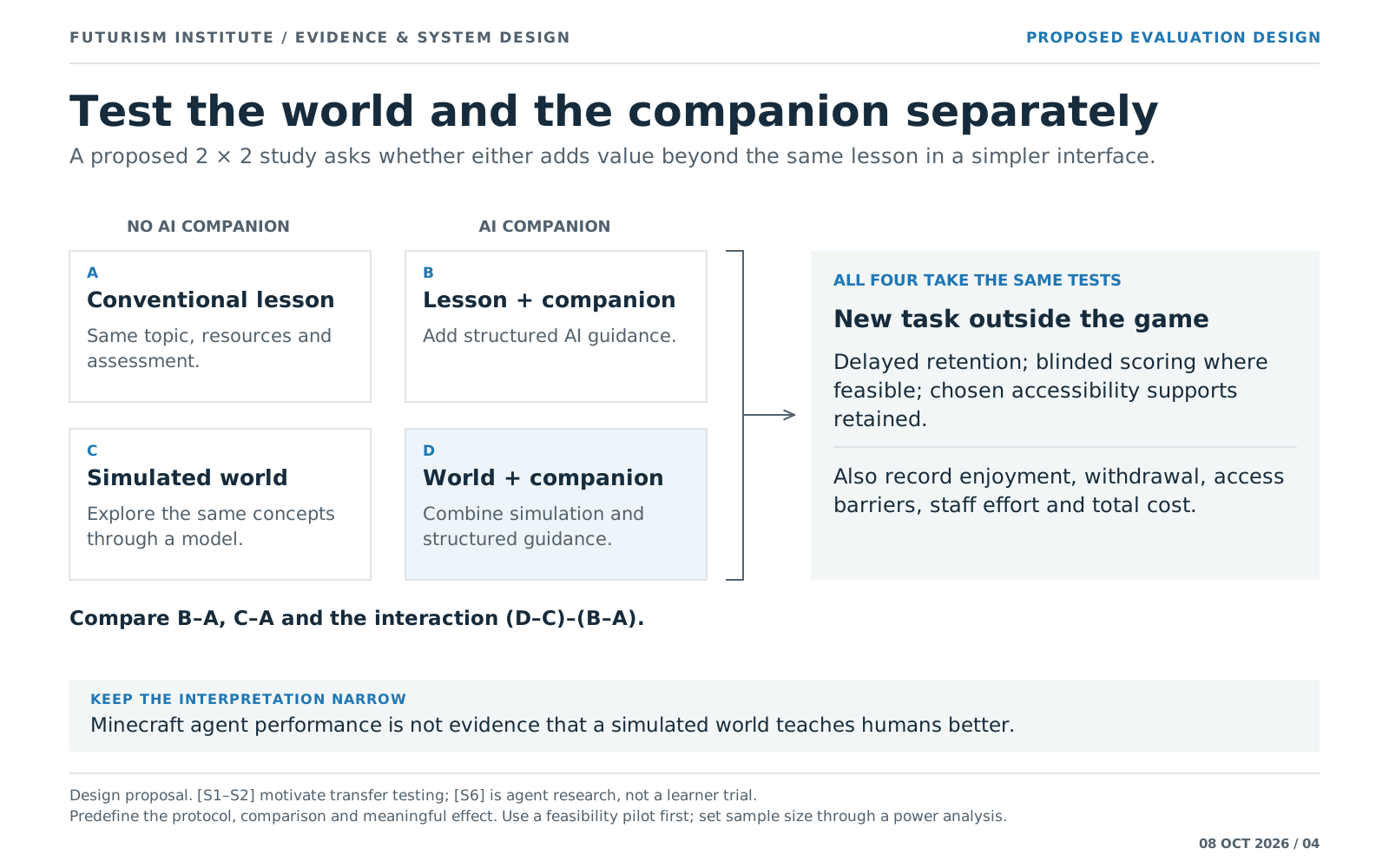
A proposed study would compare a conventional lesson with a simulated environment, each with and without an AI companion. This would help distinguish the contribution of the environment from the contribution of the tutor.
| Learning format | Without a companion | With a companion |
|---|---|---|
| Conventional lesson | Lesson and practice | Same learning aims, with tutoring |
| Simulated environment | Inspectable model and tasks | Same environment, with tutoring |
All conditions would use comparable learning aims and assessments on unfamiliar tasks. Delayed assessment would test retention. Accessibility support, time spent, prior knowledge and the cost of participation must be recorded. A study of an agent in a game, such as Voyager, does not establish that people learn from the same environment.
Original diagram: the learning comparison
Credentials need evidence behind the record
A credential could describe the task, the work shown, the conditions, the permitted assistance, the assessor and the limits of the claim. Practical demonstrations, explanations of choices and follow-up tasks are possible methods to investigate. A signature on a record cannot establish that someone has the claimed skill: the W3C credential model explicitly distinguishes verification from the truth of a claim.
Assessment integrity remains a research problem. A proposed method for detecting concealed assistance would need evidence of its accuracy, including false accusations and missed assistance, alongside privacy and accessibility review. No device-detection guarantee or recognized credential is offered here. People must be able to challenge an assessment and disclose appropriate assistive tools without being treated as dishonest.
Assistants, memory and permissions
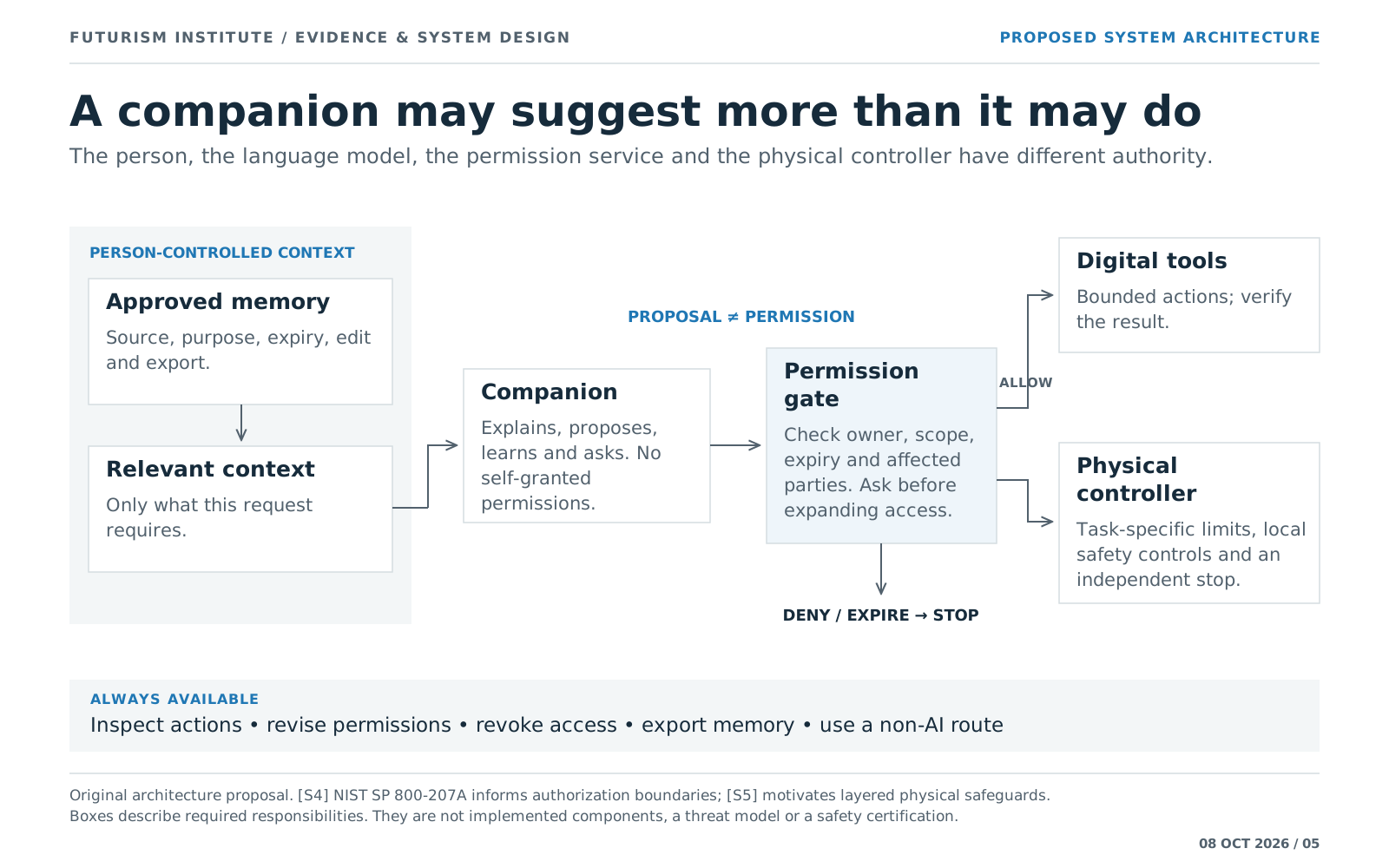
The proposed companion could explain, remember approved preferences and prepare actions. Its conversational response would not itself authorize a purchase, a booking, a disclosure or a physical action. Permission checks belong outside the model that proposes the action.
- A person sets the scopePurpose, recipient, cost, duration and permitted action.
- The assistant proposesA specific action and the information it needs.
- A separate service checksCurrent authority, limits and the affected parties.
- The tool acts and recordsOnly the permitted action, with its result and correction route.
This separation draws on NIST access-control guidance and its discussion of distinct agent identities and bounded delegation. Those sources do not certify an Institute implementation.
Share information for the task
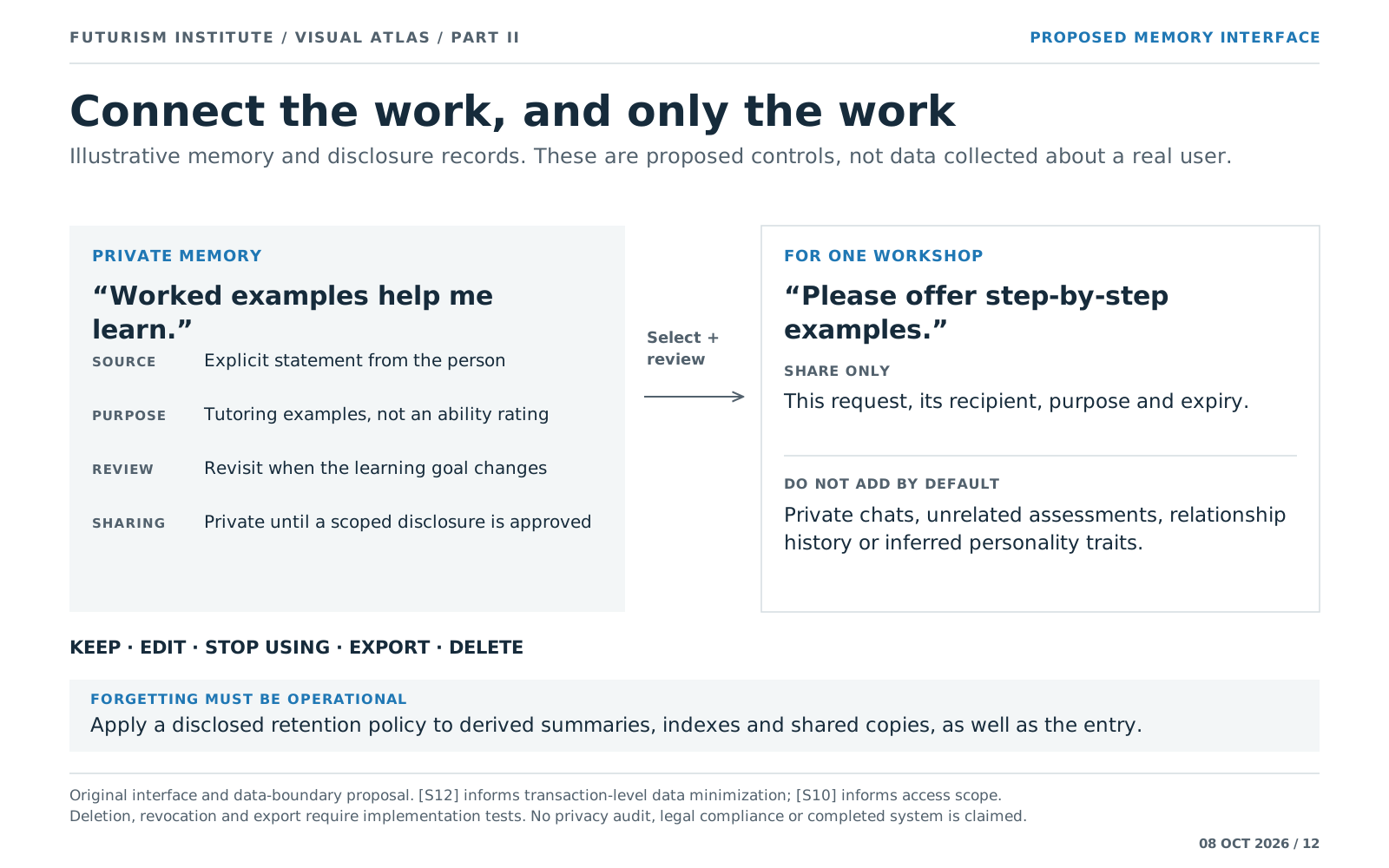
A learner might choose to save “worked examples help me” as a tutoring preference. A workshop could receive a separate request for step-by-step examples, approved for that recipient and purpose. It would not need the learner’s conversation history or an inferred ability score.
Reviewing a memory, revoking future use, exporting a record and deleting data are different operations. The design must account for derived summaries, indexes and copies already shared. A deletion control must state what it can actually remove.
Original diagrams: authority and private memory
Simulations and physical tools
Keep the model inspectable
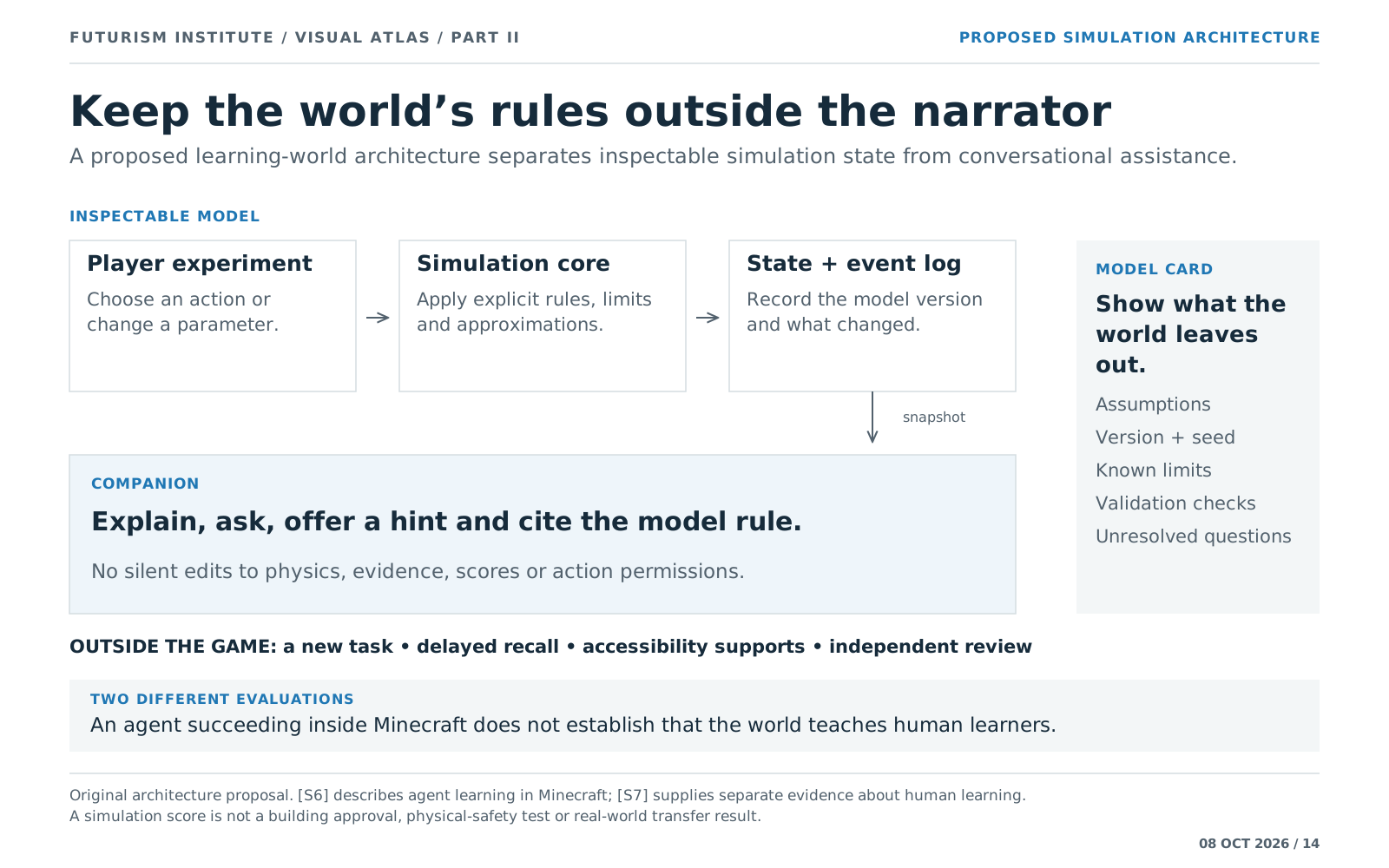
In a learning simulation, the learner changes a parameter or takes an action. A separate simulation engine applies published rules and records the state, version, seed and limitations. The companion can explain an approved snapshot or suggest another experiment; it cannot silently change the authoritative rules, history or permissions.
This makes disagreement useful: a learner can examine an assumption, compare another model and ask why the results differ. Learning is then assessed outside the simulated task, rather than inferred from progress inside it.
Original diagram: simulation and explanation
Evaluate each physical capability
A digital interface, a desk object, a mobile device and a manipulator solve different problems. Each addition needs a useful task, an account of the hazards and a fallback. Mobility adds stopping and localization requirements; manipulation adds risks specific to objects, forces and contact.
Consent to sensing or touch, guest privacy and restricted areas require separate controls. An independent stop and a recovery procedure must work without relying on conversation. Developer robotics documentation informs these questions; it is not independent certification. No physical companion is claimed to be built or validated.
Research and its limits
The atlas uses selected research to inform the design. These studies concern other interventions and settings. They are not results from the Institute, and this selection is not a systematic review.
Assisted practice and independent learning
In a high-school mathematics experiment, standard GPT-4 assistance improved practice performance but harmed subsequent unaided performance. Teacher-designed safeguards reduced that harm. Bastani et al., 2025.
Limit. A short-term result in one educational setting. It does not establish the effect of Kosplora or a general benefit from tutoring.
Design implication. Assess what a learner can do on a separate task, including after a delay.
A designed tutor in college physics
A randomized crossover study found greater immediate learning with a custom AI tutor than with the active classroom lessons used for comparison. Kestin et al., 2025.
Limit. The intervention combined pedagogy, feedback and self-paced study. Longer-term retention and other populations need separate tests.
Design implication. Specify the teaching design and comparison; “AI tutor” alone does not describe an intervention.
Serious games
A historical meta-analysis found average learning and retention benefits across mixed study designs. Motivation and the randomized learning subset had intervals that included no effect. Wouters et al., 2013.
Limit. The studies predate current AI systems. The subsets are related, and differences between them do not isolate the effect of randomization.
Design implication. Test a learning environment against a suitable lesson instead of assuming that a game improves learning.
Perceived and measured productivity
METR’s early-2025 study found that experienced open-source maintainers took longer with AI tools, despite believing they had worked faster. Becker, Rush, Barnes & Rein / METR, 2025.
Limit. Specific tools, tasks and participants. The 2026 follow-up reports selection and time-measurement problems; it is not a clean update of the original estimate. Read the follow-up.
Design implication. Measure time, quality and work completed alongside people’s experience.
Keep the underlying evidence visible
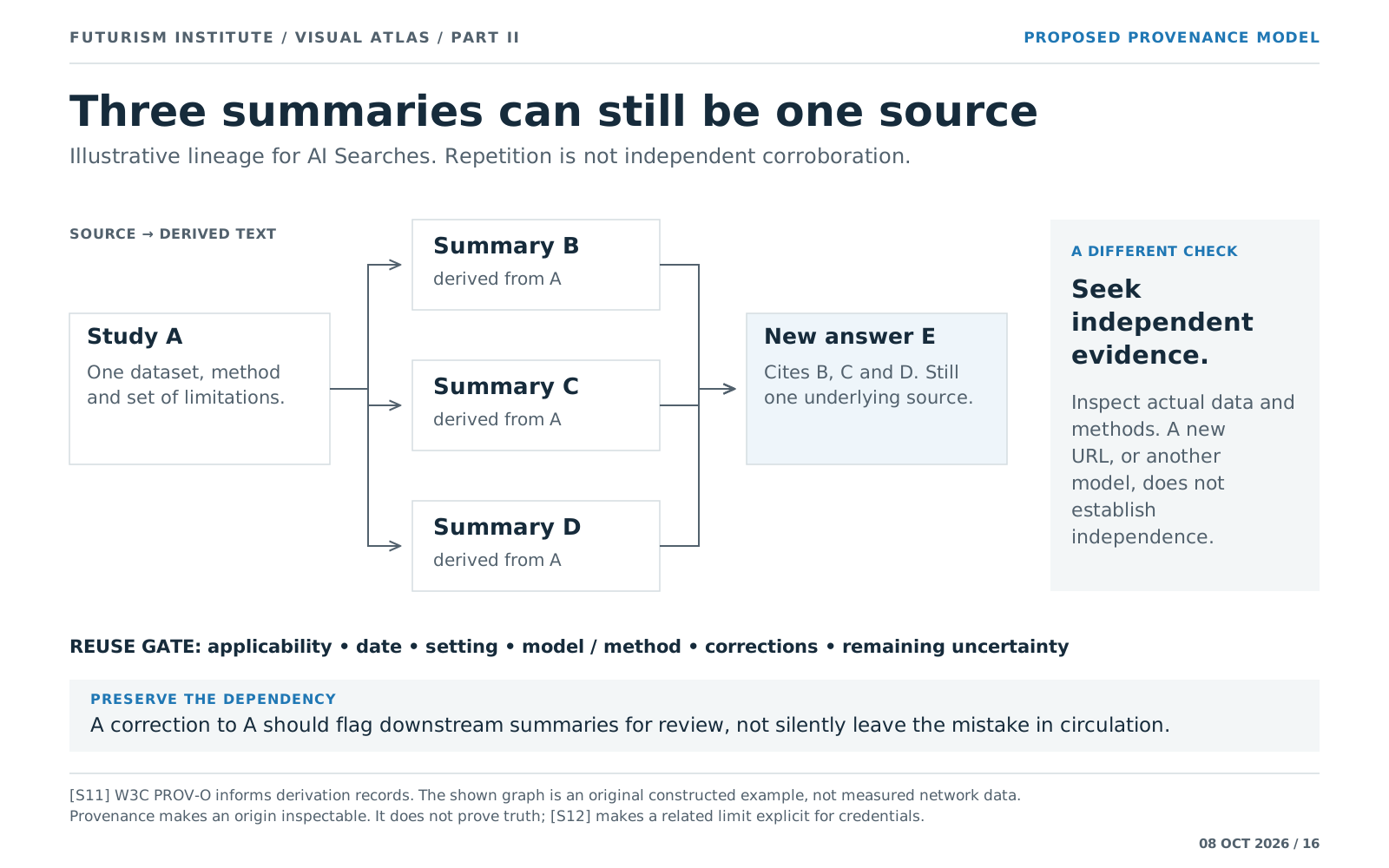
Three summaries of one study still depend on that one study. A reused answer should identify the underlying data, its setting, date, methods and corrections. Another investigation adds independent evidence only when its data or methods support that distinction.
The W3C provenance model offers a way to record derivation and attribution. It does not establish that a claim is correct. The proposed AI Searches service would need checks for applicability and correction before reusing an answer.
Original diagram: shared sources
Measure resource costs
Reuse, local processing and smaller models may change cost and energy demand. Their net benefit requires measurement for a defined task, including hardware, repeated work and maintenance. The IEA’s sector outlook provides context; global data-centre totals cannot be treated as a per-query footprint or a saving achieved by this project.
What to test next
The research agenda below identifies claims that could fail and decisions that would change as a result. These are proposed evaluations. No Institute impact measurements, success thresholds or participant sample sizes are supplied.
Learning: Can people use and retain what they learn?
Observe. A separate task, delayed assessment, access barriers and support used.
If the result is unfavorable. Revise instruction or simplify the environment.
Assistants: Does continuity help while people retain control?
Observe. Permission failures, memory corrections, unwanted initiative and ability to leave.
If the result is unfavorable. Narrow memory, actions or delegated authority.
Research reuse: Does reusing an answer save effort without repeating an error?
Observe. Applicability, source dependence, corrections, total time and resource cost.
If the result is unfavorable. Restrict reuse or return to the underlying source.
Shared decisions: Does the tool help people complete useful work?
Observe. Influence over decisions, consent, disagreement, work completed and who does it.
If the result is unfavorable. Change the process or remove the tool.
Physical tools: Does a device add useful capability?
Observe. Task benefit, hazards, stopping, recovery and effects on bystanders.
If the result is unfavorable. Remain digital or stationary.
Local services: Can the service be maintained and handed over?
Observe. Reliability, cost, paid and unpaid work, access and replacement options.
If the result is unfavorable. Change the scope, maintenance plan or ownership arrangement.
Define the comparison before interpreting a result
A protocol should specify a task, a suitable comparison, meaningful outcomes, accessibility provisions, who evaluates the work and the conditions for pausing or correcting it. Missing data, an unclear result, no detected effect and a harmful result must remain distinguishable.
- Capability
- What people can explain or do on a different task, including after a delay.
- Useful work
- What was completed and whether it met the need identified by the people affected.
- Burden
- Time, money, environmental costs, access barriers and paid or unpaid maintenance.
- Ability to leave
- Whether people can export their records, replace a tool and continue essential services.
These outcomes should stay separate. A good result on one does not cancel a serious failure on another. Favorable evidence from a limited evaluation would justify further testing; it would not establish the wider social effects of the whole system.
Sources and original atlas
This web edition is based on the visual atlas dated , with explanations of the proposed design and current project functions. The diagrams retained here are the original source images. Design implications are interpretations, not findings attributed to the cited studies.
Source register (12 references)
- Generative AI without guardrails can harm learning
Bastani et al. · 2025
High-school mathematics field experiment. Assisted practice and subsequent unaided performance are different outcomes.
- AI tutoring outperforms in-class active learning
Kestin et al. · 2025
College physics trial of a designed tutoring system. Immediate learning does not establish long-term retention.
- Key Questions on Energy and AI
International Energy Agency · 2026
Global data-centre estimates and projections. These cannot establish the footprint of this proposed system.
- A Zero Trust Architecture Model for Access Control
NIST · 2023
Technical guidance on access control. It does not certify the Institute’s proposed architecture.
- Responsibly advancing AI and robotics
Google DeepMind · Accessed 2026
Developer documentation on robotics safeguards. Independent testing is still required for a particular device and task.
- Voyager: An Open-Ended Embodied Agent with LLMs
Wang et al. · 2023
Research on an agent operating in Minecraft. It is not evidence about human learning.
- A meta-analysis of the cognitive and motivational effects of serious games
Wouters et al. · 2013
Historical meta-analysis of serious games, with mixed study designs. It does not test today’s AI learning environments.
- Measuring the Impact of Early-2025 AI on Experienced Open-Source Developer Productivity
Becker, Rush, Barnes & Rein / METR · 2025
Randomized study of experienced maintainers using early-2025 tools on their own repositories. It is not a current product ranking.
- We are Changing our Developer Productivity Experiment Design
METR · 2026
Follow-up that identifies selection and time-measurement problems. The later estimates need separate interpretation.
- Back to the Future: Why Agentic AI Needs a Strong Identity Foundation
Fisher & Galluzzo / NIST · 2026
Guidance on agent identity and delegated authority. The social-consent examples here are design proposals.
- PROV-O: The PROV Ontology
W3C · 2013
A model for recording derivation and attribution. Traceable evidence can still be mistaken or dependent on another source.
- Verifiable Credentials Data Model v2.0
W3C · 2025
A credential data model with privacy considerations. Authenticity does not establish the truth of the claims.
Download the original visual atlas PDF · 18 pages
Short summary · Original overview and drawings · Back to top