Short summary · Updated
Theory of change
I propose connecting learning resources, tools for group decisions and work in physical places, so people can understand a problem, compare options, agree on a project and check its results. The fuller version, six steps from one person to everyone, is on the theory of change page.
The intended outcomes are lasting skills, useful shared work and services people can maintain. This summary explains the proposed connections and how their effects could be assessed. The complete system has not been demonstrated.
Based on the visual atlas dated . Original PDF · 18 pages.
Available now
- KosploraA searchable educational resource library.
- Conscious ConsumingProduct and service comparisons on Values Commons, with sources and adjustable priorities.
- Dignity NeedsA reference on human needs and ways to meet them.
- The Work PartyA tool for recording a group’s decisions, responsibilities and disagreements in a file.
- Earthen BeingsA sourced directory of communities and land projects in the Pacific Northwest.
Still to be built and tested
The connected workflow described below, shared assistants and credential assessment remain development proposals.
Some individual tools can exchange files. The full sequence is not automated, and its effects on learning, cooperation and local services have not been measured.
Project status and limitationsIntended outcomes
- Learning
- People can apply what they learn to unfamiliar tasks. Assessment would check retained understanding, accessibility and the support used.
- Shared work
- Groups complete useful work with agreed responsibilities. Assessment would check what gets done, whose needs are met and who carries the costs.
- Services and resources
- People have options they can afford, maintain and replace. Assessment would check reliability, total cost, environmental effects and unmet needs.
Example: a shared learning space
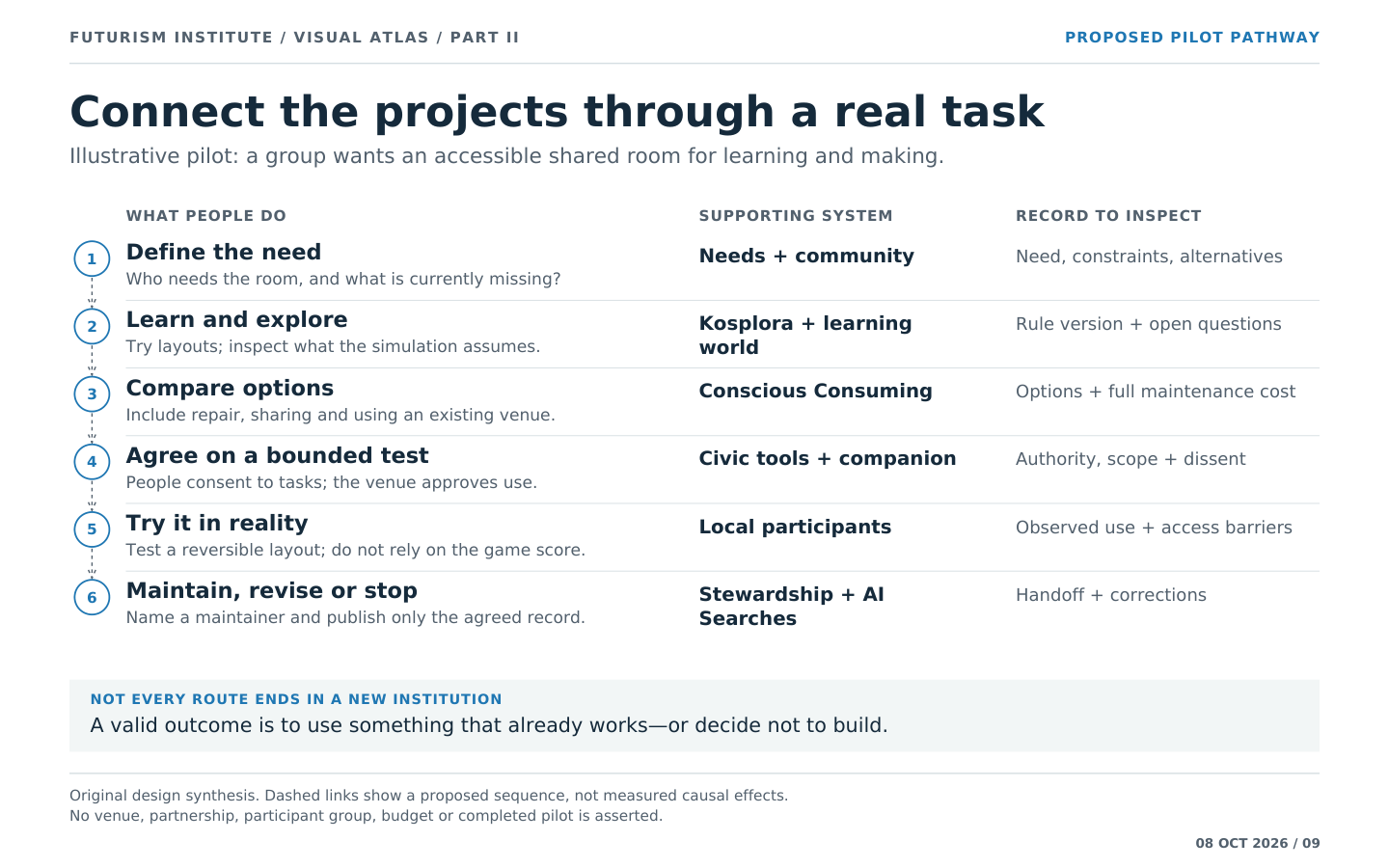
The atlas uses a room for learning and making to illustrate the proposal. This is a possible sequence, not a completed pilot. The people involved make the decisions and assess the result.
Define the need
A group identifies who would use the room, what they want to learn and which access barriers need attention.
Written recordPurpose, access requirements and budget.
Learn and explore
Members find relevant sources, practise skills and examine any models used to plan the room.
Written recordSources, assumptions and unanswered questions.
Compare options
The group compares an existing venue, shared equipment, repairs and a new space, including running costs.
Written recordAlternatives, costs and reasons for the choice.
Agree on a limited trial
The people affected decide what to test, who is responsible and when to review it.
Written recordPermissions, responsibilities, disagreements and a review date.
Observe the result
Participants record what they learn, who can use the room, what it costs and how much work it requires.
Written recordObserved benefits, access barriers, costs and maintenance work.
Maintain, revise or stop
The group reviews those observations and decides whether to continue, change the arrangement or end it.
Written recordA decision, its reasons and any continuing responsibilities.
Using an existing service or deciding against a new project are also possible outcomes.
View the original project-pathway diagram
Design requirements
- People control what personal information is retained and shared.
- An assistant needs specific permission to act. One person’s approval cannot commit others.
- Simulation rules and records can be checked independently of an assistant’s explanation.
- Sources keep their dates, limitations and corrections. Summaries of the same study do not count as independent evidence.
- Physical devices need safety testing for their intended task and an independent way to stop them.
Evidence needed
Evaluation would compare results with simpler options, including existing services. It would measure learning on a separate task, work completed, time, cost, access barriers and whether people can leave without losing access to essential services.
The atlas cites studies of learning and productivity. Those findings do not establish the effects of this proposed system. The PDF includes sources and their limitations.